
第 1 课
学习新汉字 (7/14)
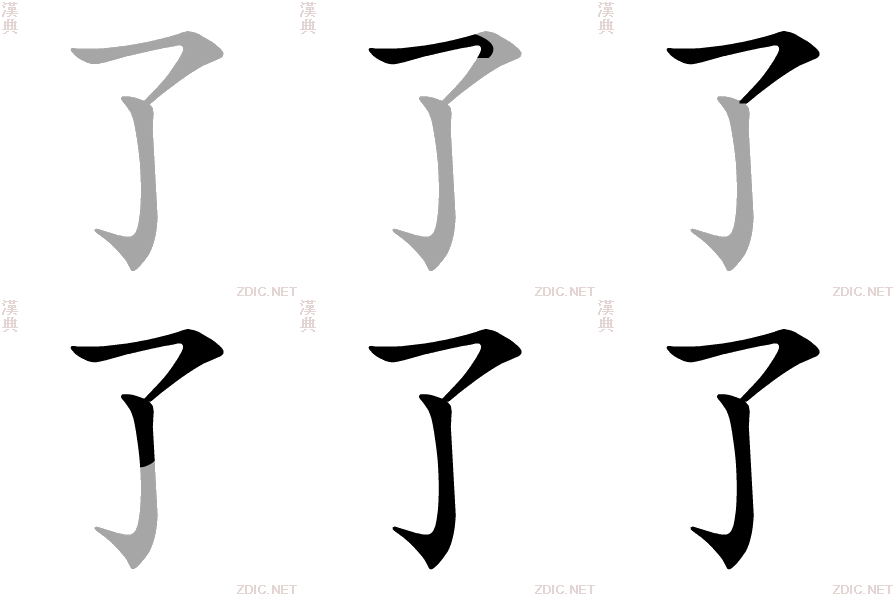
Brief explanation:
to finish, to end;
to understand, to know;
completely, entirely (used in negatives or emphasis);
Etymology:
"了" is a single-component character, classified as a pictograph.
Etymology and Evolution:
-
Oracle Bone Script:

 The Oracle Bone Script form of the character “子” depicts an infant with arms outstretched and waving, full of vitality and a sense of beginning. In contrast, the infant in the character “了” is shown with limbs curled and drawn inward, representing "the state of the infant at the very moment when childbirth is completed." The ancients used this "completed state of a monumental process" to metaphorically express the abstract concept of "ending" or "conclusion."
Some scholars (such as Lin Yiguang) propose that the ancient form of “了” resembles thread or rope being twisted, entangled, and drawn tight. When a thread is twisted to its very end, it naturally reaches its "conclusion." This interpretation more directly links the action of "drawing together" with that of "ending."
Whether it is the "drawn-in infant" or the "bound thread," the core imagery is one of "coiling, entangling, and reaching an endpoint," from which the meaning of "completion" is derived.
This character-formation method showcases the dialectical thinking in Chinese character philosophy—where "the beginning is the end, and the end is the beginning"—as well as the exceptional wisdom of using concrete, vivid life phenomena to express abstract concepts.
Bronze Script:
Inherits the oracle bone form, with a more regularized structure while retaining the curled human figure.Small Seal Script (Shuowen Jiezi):
The character becomes more linear, written as "了." Xu Shen explains it as "尦也" (meaning legs crossed while walking), extended to mean "conclusion" or "completion."-
Clerical and Regular Script:
 Evolves into the modern form "了," with simplified strokes losing its pictorial quality and becoming an abstract symbol.
Original and Extended Meanings:
Original Meaning: To end, to finish, as in "了结" (settle) or "了断" (conclude).
-
Extended Meanings:
To understand, to know: e.g., "了解" (understand), "了然" (clear).
Aspect particle: Placed after a verb to indicate completion, e.g., "吃了饭" (have eaten).
Modal particle: Indicates change or affirmation, e.g., "下雨了" (It's raining now).
Completely (in negatives): Since "completion" implies that nothing remains, the expression "了无痕迹" (without a trace) came into being.
字源:
注册体验学习、练习、复习全流程
- 每天学习一节课
- 在线练习直至记住
- 每天复习所有学过的内容,防止前学后忘
- 系统自动记录,重点复习你最需要练习的,高效学习,免除无效重复
- 90 天后拥有开始中文阅读的基本词汇量