
第 1 课
学习新汉字 (2/14)
|
HSK (1)
|
||
|
白
|
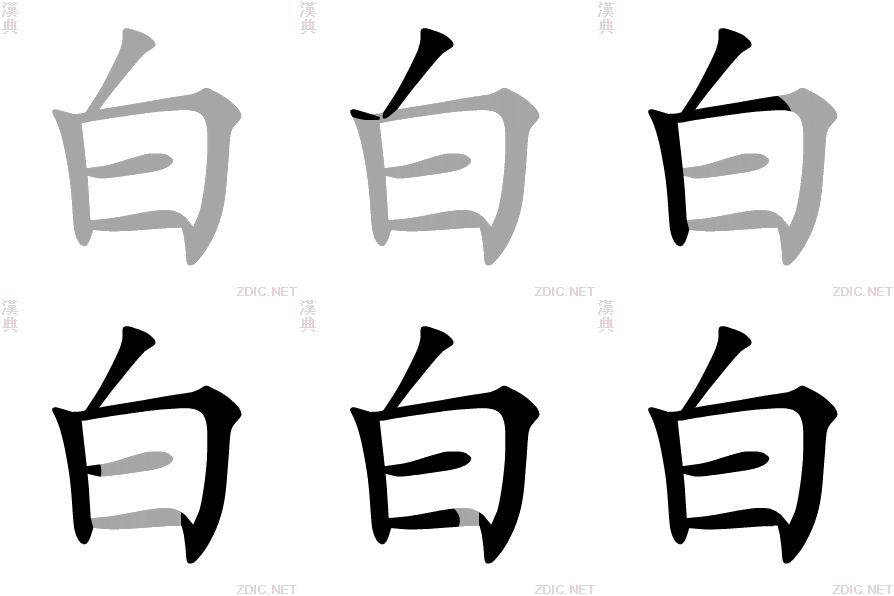
|
|
|
白
|
||
|
|
||
Brief explanation:
white;
clear, obvious;
blank, empty;
in vain, fruitless;
symbolizing purity or funeral;
Etymology:
"白" is a single-component character, classified as a pictographic character.
Etymology and Evolution
Oracle Bone Script:
 There are several scholarly views on the origin of "白," but the mainstream interpretation relates it to "sunlight" or "a grain of rice." The predominant "sunlight theory" suggests that its shape resembles the rising sun, with a central indicator symbol (a horizontal or dot line) emphasizing the sun's radiance and core, symbolizing brightness and the color white. The oracle bone form is simple yet highly symbolic.
Bronze Script:
 It inherits the oracle bone form, with a more regular and linear structure, while maintaining the basic composition—pointed at the top and wider at the bottom, often with a prominent stroke in the middle.
Small Seal Script (from Shuowen Jiezi):
 The character becomes more standardized, written as "白." Xu Shen, in the Eastern Han dynasty's Shuowen Jiezi, adopted the "grain of rice" theory, explaining it as: "白 represents the color of the west. When yin principles are active, things are white in color. It is composed of '入' combined with '二'; '二' is an even number, representing yin." He believed the character combined "入" (enter) and "二" (two), associating it with yin-yang and the five phases (the west corresponds to metal, whose color is white). Modern paleography largely considers this a later rationalization, not the original intent behind the character's creation.
Clerical and Regular Scripts:
 The strokes become straight and horizontal, solidifying into the modern form "白," where the top pointed angle becomes a flat left-falling stroke, and the bottom becomes square.
Original and Extended Meanings:
-
Original Meaning: The color resembling sunlight or frost and snow, i.e., white.
-
Core Extended Meanings (derived from "bright" and "pure"):
-
Bright, Clear: Extended from the visual impression of whiteness.
-
Blank, Pure: Extended from the physical property of the color white.
-
To State, To Explain: To make things clear and understood.
-
In Vain, For Free: Extended to mean "empty/nothing" or "without effect."
-
(Colloquial) A Mispronounced or Miswritten Character: Similar in sound to "别" (bié), indicating a wrong pronunciation or written form.
-
Cultural Connotations:
"白" holds rich meaning in Chinese culture. It is not only one of the five primary colors, corresponding to the west, autumn, and metal in the traditional five-phase system, but also symbolizes purity, mourning (funeral affairs are called "白事"), and simplicity (as in "素白"). In philosophy and aesthetics, "白" often represents a starting point, emptiness, and infinite potential, such as the "blank space" (留白) in Chinese painting. Understanding the character "白" helps in deeply appreciating the unique cultural logic and philosophical concepts carried by color terms in the Chinese language.
字源:
甲骨文:
主流解释为“日光”或“米粒”。字形像一轮初升的太阳,中间的指示符号(一横或一点)强调太阳的光芒与核心,整体象征明亮、白色。甲骨文字形简洁而富有象征性。-
金文:
继承甲骨文,字形更加规整和线条化,但基本结构保持一致,上尖下宽,中间常有突出的一笔。 小篆(《说文解字》):
字形进一步规范化,写作“白”。东汉许慎在《说文解字》中采纳了“米粒说”,解释为:“白,西方色也。阴用事,物色白。从入合二;二,阴数。” 他认为字形是“入”和“二”的组合,并附会了阴阳五行(西方属金,其色白)之说。现代文字学多认为此说属于理据重构,并非最初造字本意。-
隶书与楷书:
笔画变为平直,基本定型为现代所见的“白”字,上部的尖角变为平撇,下部为方形。
文化内涵:
“白”在中国文化中意义丰富。它不仅是五种正色之一,在传统五行中对应西方、秋天和金,象征纯洁、哀悼(丧事称“白事”)、质朴(如“素白”)。在哲学与美学上,“白”也常代表起点、虚空与无限可能,如中国画中的“留白”。理解“白”字,有助于深入体会汉语中颜色词所承载的独特文化逻辑与哲学观念。
注册体验学习、练习、复习全流程
- 每天学习一节课
- 在线练习直至记住
- 每天复习所有学过的内容,防止前学后忘
- 系统自动记录,重点复习你最需要练习的,高效学习,免除无效重复
- 90 天后拥有开始中文阅读的基本词汇量