
第 1 课
学习新汉字 (9/14)
|
HSK (3)
|
||
|
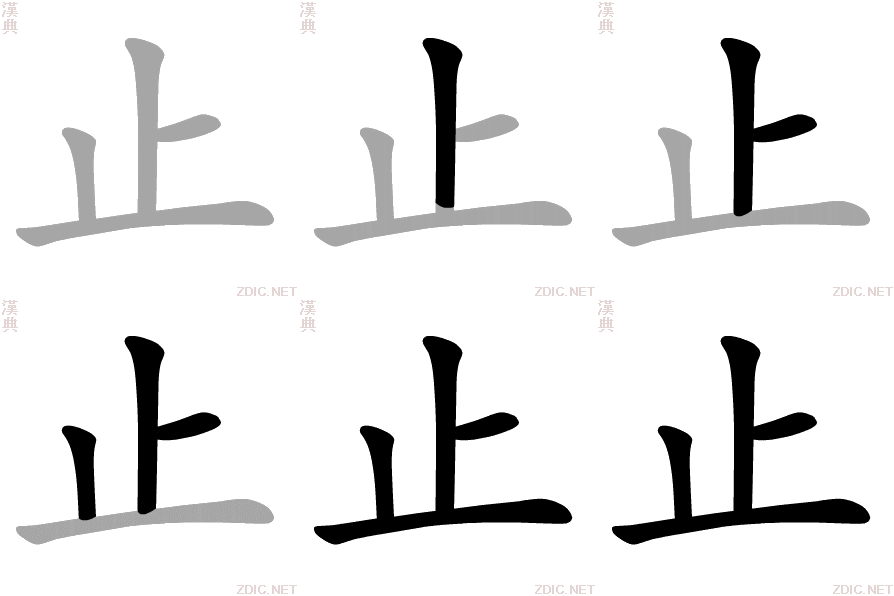
止
|
|
|
|
止
|
||
|
|
||
Brief explanation:
to stop;
Etymology:
“止” is a single-component character, categorized as a pictogram.
Etymology and Evolution
Oracle Bone Script:
 Resembles a simplified foot, highlighting the toes. It typically depicts three toes or a generalized outline, representing a human foot.
Bronze Script:
 Inherits the oracle bone form, with a more regularized foot shape that emphasizes the connection between the sole and toes.
Small Seal Script (Shuowen Jiezi):
 The character becomes more linear, written as “止”.
 Clerical and Regular Script:
 Evolves into the modern form “止,” with strokes straightened and the foot shape abstracted into horizontal and vertical lines.
Original and Extended Meanings
Original meaning: Foot.
-
Extended meanings:
-
To stop, cease: The oracle bone character depicts a complete foot planted firmly on the ground. When your foot steps forward, lands, and settles firmly, that step is complete. The ancients abstracted this concrete scene of "the foot landing, a step completing" both philosophically and semantically:
Spatially: The place where the foot lands and stands firm is where the movement arrives (the character “止” is cognate with “至,” meaning "to arrive"), i.e., the endpoint of the journey.
Temporally: The moment the foot lands and stands firm is when the forward motion pauses or ends.
Thus, the meaning of “止” naturally expanded from a concrete point of completed action (the foot touching down and holding still) to the general concept of all actions "stopping, ceasing to proceed."
To cause to stop: e.g., “制止” (restrain), “止血” (stop bleeding).
-
注册体验学习、练习、复习全流程
- 每天学习一节课
- 在线练习直至记住
- 每天复习所有学过的内容,防止前学后忘
- 系统自动记录,重点复习你最需要练习的,高效学习,免除无效重复
- 90 天后拥有开始中文阅读的基本词汇量