
第 1 课
学习新汉字 (10/14)
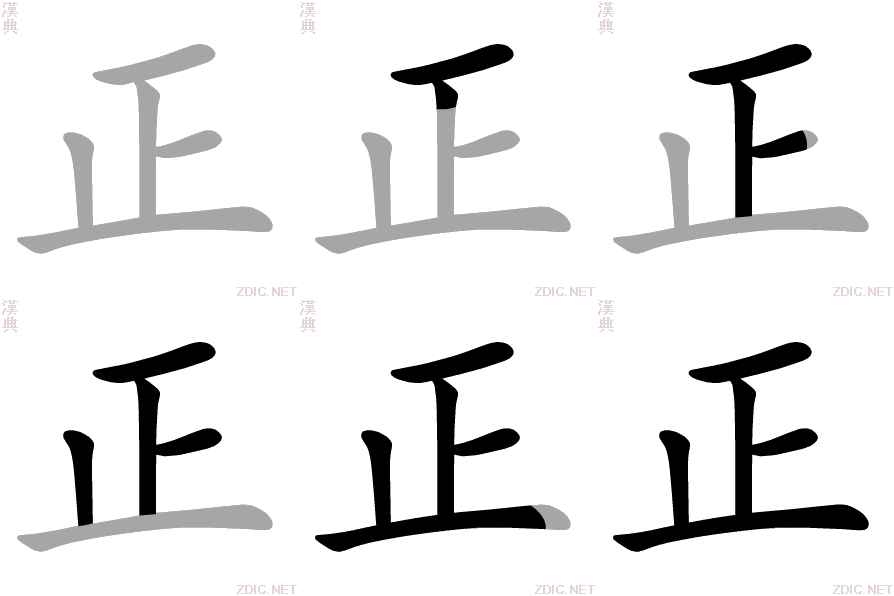
Brief explanation:
straight, correct;
upright, proper;
to correct, to rectify;
in the process of (action);
exactly, just;
Etymology:
"正" is a single-component character, classified as an ideographic character.
Etymology and Evolution
Oracle Bone Script:
 The character consists of an upper part "口" (or a square, representing a settlement or destination) and a lower part "止" (a footprint shape, representing walking or advancing). The composite form signifies marching toward a set target or settlement. Its original meaning is the same as "征", meaning to go on a military expedition, to campaign.
Bronze Script:
 It inherited the structure from the oracle bone script, with more regularized lines. The shapes of the "止" and the square above became clearer and more stable.
Small Seal Script (《Shuowen Jiezi》):
 The form became more linear and standardized, written as "正". Xu Shen explained it as "是也。从止,一以止。" This interpretation already leaned towards its extended meaning of "correct, upright," suggesting that the character depicts a "止" (foot) stopping at "一" (representing a standard or boundary), indicating behavior conforming to norms.
Clerical Script and Regular Script:
 The strokes were straightened. The "口" shape gradually flattened into a horizontal line, eventually evolving into the modern standard form "正".
Traditional and Simplified Form Note:
The character "正" itself has no traditional vs. simplified distinction; it is a inherited character. Its original function as the phonetic and semantic root for "to campaign" was later taken over by the character "征", which adds the "彳" (walk) radical.
Original and Extended Meanings:
Original Meaning: To go on a military expedition, to campaign (this meaning was later assumed by the character "征").
-
Basic/Core Extended Meaning: Straight, upright, level. This was abstracted from its original sense of "heading toward the correct target."
-
Extended Meanings:
-
Upright, righteous: Behavior conforming to norms and morality.
-
Correct, accurate: Conforming to standards, facts, or expectations.
-
Pure, unadulterated: The main or principal part.
E.g., 正色 (pure color; stern expression), 正宗 (authentic), 正本 (original text; to get to the root of a matter).
-
The front or primary side of something: Opposite of "反" (reverse) or "副" (deputy, auxiliary).
E.g., 正面 (front side; positive aspect), 正职 (primary/post), 正反 (positive and negative; pros and cons).
-
To straighten, to rectify, to govern: Used as a verb.
-
Indicates the progression of an action or the continuation of a state: Used as an adverb.
-
注册体验学习、练习、复习全流程
- 每天学习一节课
- 在线练习直至记住
- 每天复习所有学过的内容,防止前学后忘
- 系统自动记录,重点复习你最需要练习的,高效学习,免除无效重复
- 90 天后拥有开始中文阅读的基本词汇量